Editors: Guillermo Echanique
Jan Potemkin
Sheera Joy Olasky
James Gouijn-Stook
Albert Lee
Journal of the Chogye International Zen Center of New York
On the Occasion of the Chogye International Zen Center of New York’s 51st Anniversary
This commemorative issue of Woodfish celebrates the 50th anniversary of our Zen Center and arrives as we enter our 51st year. We have a new editorial staff and have re-designed many of our features.
In the following pages, and through the links to additional material, we present a living record of our community, past and present. At its center is the dharma talk and calligraphy from Zen Master Seung Sahn for the opening ceremony, grounding this issue in the spirit of our founding. Accompanying this are recollections from members across generations, along with photographs, original poetry, writing, and artwork—voices and forms that together reflect the continuity and diversity of our shared path.
Please enjoy it and always feel welcome to contribute to our upcoming issues.
In this issue:
CIZCNY’s Timeline
Looking back, the essential story is this: from a borrowed Sunday room at Times Square, to a stripped loft on 20th Street that we built out ourselves, to a purchased building near the Empire State Building, the Zen center in New York was created through direct effort—construction work, community support, dedication ceremonies, chanting, and daily practice. It grew not from resources but from commitment.
—Linc Rhodes JDPSN

A Dharma Talk
Given by Zen Master Seung Sahn at the opening ceremony of the International Zen Center of New York on April 20, 1975
(Holding up his Zen stick and hitting the table, slowly, three times)
Is this closed? Is this open?
If you say "closed", you fall into the hell without doors. If you say "open", you are dancing with all demons.
Why?
(Holding up the Zen stick and tracing a circle in the air; then holding the stick perpendicular on the table)
One two three four; five six seven eight.
(Holding up his Zen stick and hitting the table, slowly, three times)
Is this closed? Is this open?
If you say "closed", you fall into the hell without doors. If you say "open", you are dancing with all demons.
Zen Master Seung Sahn at the dedication ceremony for 400 E 14th Street, 1987
Why?
(Holding up the Zen stick and tracing a circle in the air; then holding the stick perpendicular on the table)
One two three four; five six seven eight.
(After a few moments) Thank you very much for coming to our ceremony even though you must be very busy. It is not an accident that we are gathered here today. It is the result of our past karma. It is very good karma that has brought us to meet here in front of the Buddha's altar.
This karma means finding our true self and attaining the Absolute. It means leaving behind the world of corruption and journeying to the pure land of true freedom and peace.
That is why we founded Won Gak Sa one year ago and are opening the International Zen Center of New York today.
But the sutra says, "Form is emptiness, emptiness is form." So all names and all forms are emptiness. Won Gak Sa, the International Zen Center of New York, this opening ceremony - these also are emptiness.
The sutra says, "All beings are already Buddha." So why is Yom Bul or reading sutras or sitting Zen necessary?
But we don't know ourselves. Desire, anger and ignorance cover up our clear mind. If we cut off all thinking and return to empty mind, then your mind, my mind, and all people's minds are the same. We become one with the whole universe.
Therefore an eminent teacher said, "All things in the universe return to the One.''
True empty mind is before thinking. So thinking does not appear and does not disappear. This is the realm where nothing appears or disappears.
In the realm where nothing appears or disappears, there is no life and no death, no suffering and no happiness, no good and no bad, no you and no I. So it is said that all things in the universe return to the One.
But where does this One return?
Once somebody came up to the great Zen Master Mang Gong and asked him, "If all things return to the One, where does this One return?" Mang Gong said, "The spring geese are flying north.''
What do you think this means - "the spring geese are flying north?"
Even though you may understand enough to smash Mount Sumeru into a million pieces and swallow the ocean in one gulp, you will not understand this.
Even though you may understand enough to kill or give life to all the Buddhas of the three time-worlds and all eminent teachers and all people, you will not begin to understand this.
Then how can you understand the true meaning of "The spring geese are flying north?" Only keep don't-know mind. This don't-know mind is the mind that is stuck and cannot budge. It is like trying to break through a steel wall or trying to climb a silver mountain. All thinking is cut off. But as soon as you penetrate this condition, your mind will explode. Then you can see the stone lion run across the waves and devour the sun.
But you will still be bewildered. Go one more step. Then you will arrive at your true home, where spring comes and the flowers are blossoming everywhere. If you arrive here, not only will sutras and bibles be true, but also the sound of water and wind, the color of the mountain, the barking of a dog in the street everything that you see or sense, everything as it is will be the truth.
Therefore Zen Master Mang Gong said, "The spring geese are flying north.'' The truth is just like this.
All things in the universe return to the One; where does the One return? Throw away Small I and enter Empty I. Then, when you open your eyes, everything that you can see and hear will be like this.
A little while ago I hit the table three times. Mang Gong said, "The spring geese are flying north." The meaning of my action and the meaning of Mang Gong's words - are these the same or different?
If you say ''the same", I will hit you thirty times. If you say "different", I will still hit you thirty times.
Why?
KATZ!!!
Open the front door to Broadway.

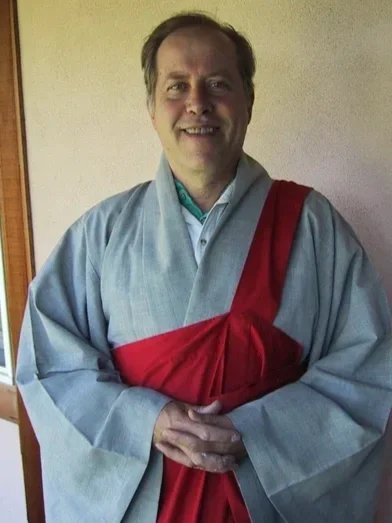
Guillermo Echanique conducted a long interview with Linc Rhodes, who was involved with the Zen Center from the very beginning.
Interview with Linc Rhodes, JDPSN
Linc Rhodes, JDPSN
The Chogye International Zen Center of New York was formally founded on April 20, 1975, at its location near Union Square in New York City. Yet the pilgrimage that led to that moment had begun years earlier, through meetings, chance encounters, and the gradual gathering of a small community dedicated to Zen practice.
From those early beginnings, the Center would move through a series of spaces across the city as the sangha grew and circumstances changed. What follows is a timeline of its travels, as recounted by Zen Master Jok Um (Ken Kessel).
A Historical Recounting
Click the link at the end of each section to read the recollections of Sangha members who were introduced to the Zen Center in that period.
1975-1979
1975-1977: 40 East 20th St
Sometime in 1975, Zen Master Seung Sahn (addressed as Dae Soen Sa Nim) was in a diner in New York with Poep An Sunim, who was a highly esteemed calligrapher who had been vice-president of Dong Guk University, the Buddhist university in Seoul. A Korean woman, Choi Bosalnim, approached them and said that if they opened up a temple in Manhattan, she would take care of the expenses.
Somehow, they acquired a space in a building on 40 East 20th Street. Zen Master Seung Sahn asked Linc Rhodes and Jerry Shrair, from Cambridge Zen Center at the time, to come down. While the construction went on, they lived there. Poep An Sunim also moved in. They named the site Won Gak Sa, and it served as a temple for the Korean community and functioned as a Zen Center, with twice-daily practice and a retreat schedule, for the American sangha. The Korean sangha came weekly for Sunday services, and I’m guessing that people frequently showed up for help from Poep An Sunim. He also raised money by making and selling calligraphy, which people would purchase as donations to the temple. This is a customary way of supporting temples in Korea.
Calligraphy by Zen Master Seung Sahn in honor of the founding of the Chogye International Zen Center of New York
1977-1978: 105 East 16th St
After several years at Won Gak Sa, sharing a small space for multiple functions became complicated, and the Zen Center moved to a place that was offered by a Korean student of Dae Soen Sa Nim, Sun Ok Lee. Sunny had the status of “national treasure” in Korea as a classical dancer, and she also did modern fusion choreography with her own dance company. She had the full second floor at 105 East 16th Street, off Union Square. Her apartment was in the front section, and the very spacious dance studio was in the back. She made some modifications to the studio, so that it was able to serve as a zen center as well. We practiced there for several years, even holding a weekend Kido at one point.
When Zen Master Seung Sahn would come to New York, he would stay there, and we would practice together with him in the early morning. Following one of these practices, we had a meeting with him. The members were saying that it would be hard for them to commit to covering morning and evening practice continuously throughout the week. Dae Soen Sa Nim responded that if we couldn’t do that, and could only meet on a few days, that would be fine – but then we’d be a Zen Club, not a Zen Center, and rather than coming down monthly, he’d only come a few times a year. That was enough to induce everyone in the room to volunteer their time and that eventually filled up the whole week.
Later, around 1978, Sunny had to sell the front part of her studio. The smaller remaining space couldn’t accommodate the Zen Center, and Carole Marshall offered to let us use her apartment at 11 East 7th Street, a few doors down from the landmark McSorley’s Ale House, as our center. We held not only regular practice but retreats as well in that space, thanks to her generosity. Since the space was small, when he came to New York at that time, Dae Soen Sa Nim often stayed with an American student of his, Maureen Guiney, who lived in Peter Cooper Village. Whoever happened to be driving him to New York stayed there as well, and people would show up for morning practice.
1978-1979: 11 East 7th St
1979-1987
1979-1984: 39 East 31st St.
In 1978, his Korean students arranged to buy a building at 39 East 31st Street. There was a diner on the ground floor, a space that was being vacated on the second, and the top three floors were rented out as apartments. Dae Soen Sa Nim asked me to move to New York to live there and be the director. We closed on the building and were able to move in in January of 1979. Mu Bul Su Nim, Linc Rhodes, Mu Deung Su Nim (later Zen Master Su Bong), Larry Sichel (later Zen Master Dae Bong), David Klinger and several others all came down to do the construction. Somehow, once there was a sufficiently usable area, we were able to do a full practice and retreat schedule in the still-under-construction space. The building was bought by the Korean community, under the corporate and temple identity of Korea Buddhism Jogei Temple of America, and we remained the Chogye International Zen Center of New York, again sharing the same space. We next acquired the fourth floor, and eventually the whole building, as the residential sangha grew. The dharma room had a deep-blue rug, much like the one at the old Providence Zen Center, and the Korean community had supplied some ornate lanterns for the four corners of the room (which somehow, once we moved, presaged the simpler rice-paper lanterns we now have). The Korean sangha held its Sunday services again and managed other ceremonial occasions. We had a succession of Korean monks who lived there over the years. Mahaghosananda, a famous monk from Cambodia, often stayed at this temple when he visited New York. Syndria Meacham was living there during those years, and they became close and he remained a friend of our sangha.
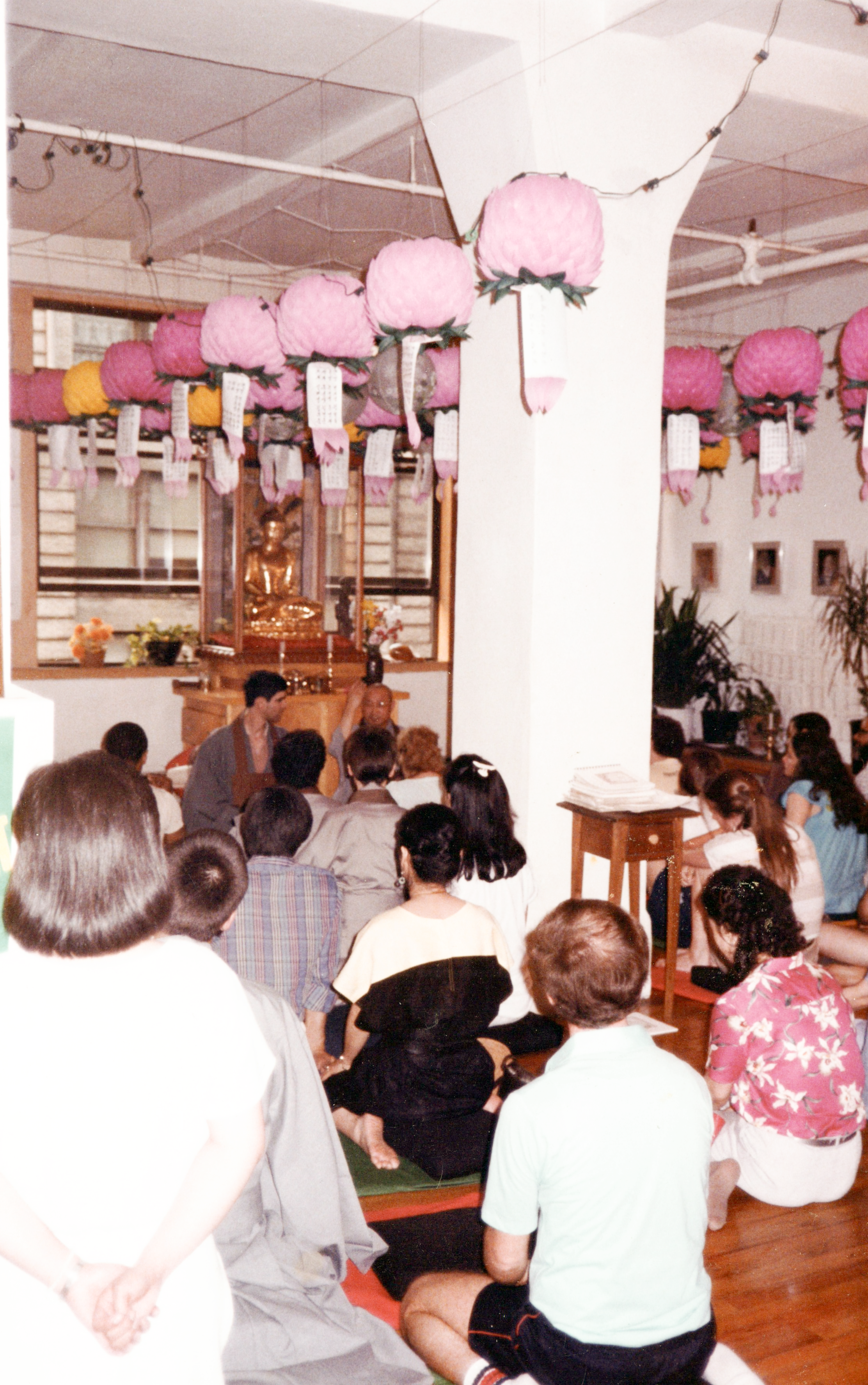
A dharma talk at 42 W 17th Street
1984-1987: 42 West 17th St
In 1983, the building became more than we could manage. We sold it and rented a space together at 42 West 17th Street. A Korean nun, Do Myung Su Nim, lived in one of the rooms and served the Korean community. Syndria lived in the other room. Eventually, as with Won Gak Sa, it became clear that it was too complicated to manage two sanghas in one space. The Korean community moved to Woodside and renamed their temple Chogye Sa. The Zen Center searched for a new space.
1987-present
400 East 14th St
We found the space we now have on 400 East 14th Street in 1987. At that time, we only had the left-hand apartment (2E) at the end of the hall, which was a one-bedroom with a living room, bath and kitchen. When the apartment across the hall (2D) became available, we bought it, joined the two apartments, and expanded the original space to the dharma room we now use. Jeff Kowatch, an artist who had also worked in construction, directed the construction of the current dharma room and re-constructed the other space to have two bedrooms and our robe room. Mark Ekwall did a lot of the work and various “amateurs” pitched in. This is the arrangement we have had since we moved to this location
Art and Poetry
Click on the links below to see artwork and poetry contributed by Sangha members
The Persistence of Diligence - Zen Master Jok Um
The Way In - Jan Potemkin
May the Buddhas of Antiquity Amplify My Stride - Rayan Fardoun
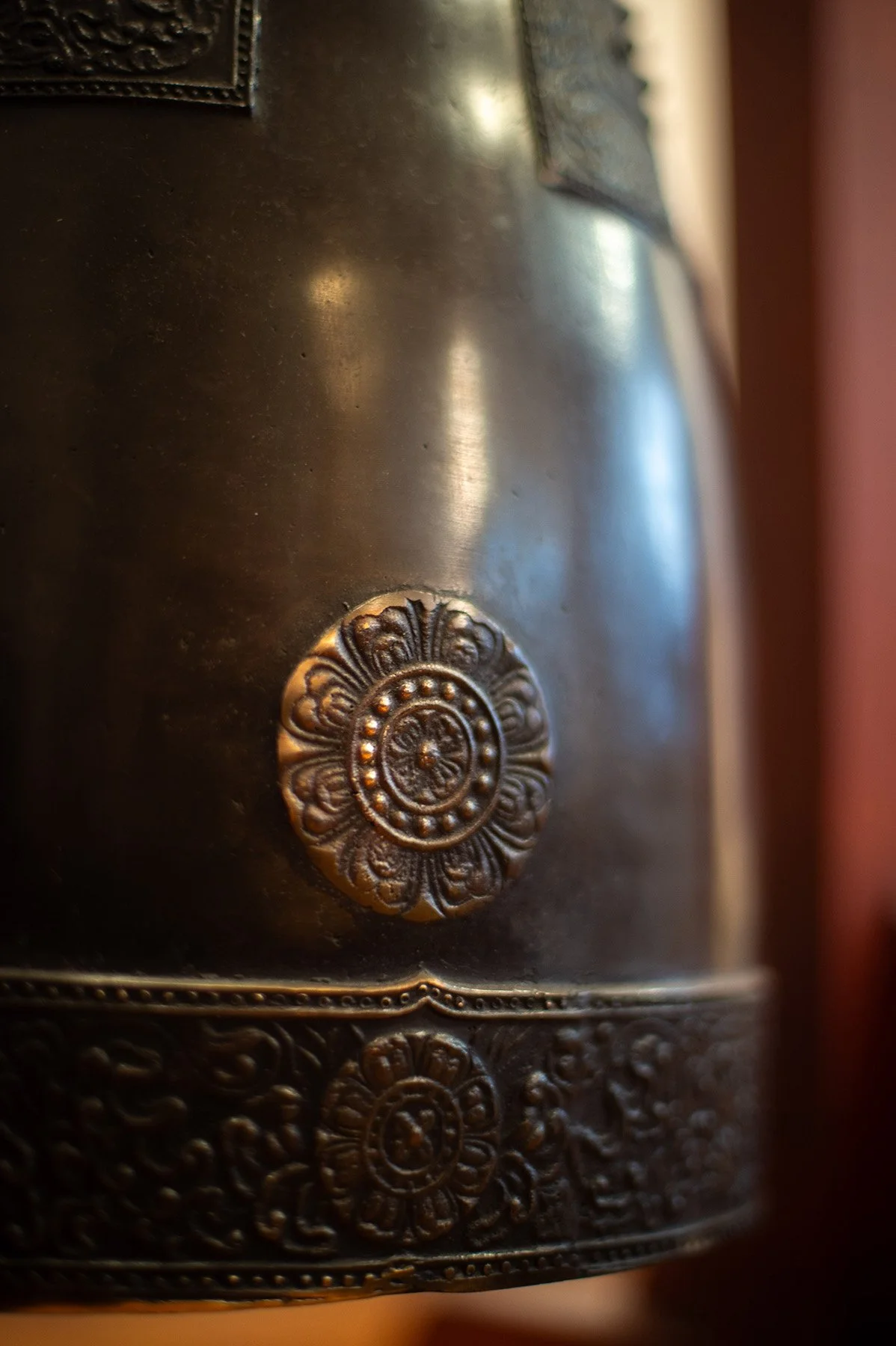
The bell at 400 E 14th St
No Bells or Whistles
by John Holland
Lisa Annese has been using the sound vibrations from Tibetan singing bowls, gongs, drums, and flutes for some years at the senior citizen center where I have been living for the past year. She gathers many more nonagenarians than do I when I lead meditation. It’s easier to absorb music than to practice Zen.
I have told those few who come about our practice of kong-an dharma combat, holding up a glass of water, and then asking them “What is this?” Then telling them, “If you say it is a glass, then you are attached to name and form. But if you say it’s not a glass, then you are attached to emptiness. What can you do?” I follow by asking, “What is your original face before your parents were born?” This elicited a question posed by my tablemate, “If the Universe and all in it are infinite, what is the search for meaning?” In answer to which I hit the table, and then asked him to ask me, “Is that all?” Then I told Roger to look under the table.
It’s not surprising that as we sit in chairs I am asked about death by my fellow ninety-year-olds. I reply that there is a tradition in Buddhism of rebirth but that in fact we don’t know what happens.
I find it interesting that a few would-be Zennists take the company bus on Sundays to a Catholic church.
Yesterday when Sal died I recited the seventeenth-century poem:
The Human Route
Coming empty-handed, going empty-handed, that is human.
When you are born, where do you come from?
When you die, where do you go?
Life is like a floating cloud which appears.
Death is like a floating cloud that disappears.
The floating cloud itself originally does not exist.
Life and death, coming and going are also like that.
But there is one thing which always remains clear.
It is pure and clear, not depending on life and death,
Then what is the one pure and clear thing?