
Editors: Guillermo Echanique,
Paul Majchrzyk,
Zsuzsanna Sildo,
M.K. Babcock,
Clare Ellis
Calligraphy: Sung Hae Sunim
Layout: James Goujin-Stook
Newsletter of the Chogye International Zen Center of New York
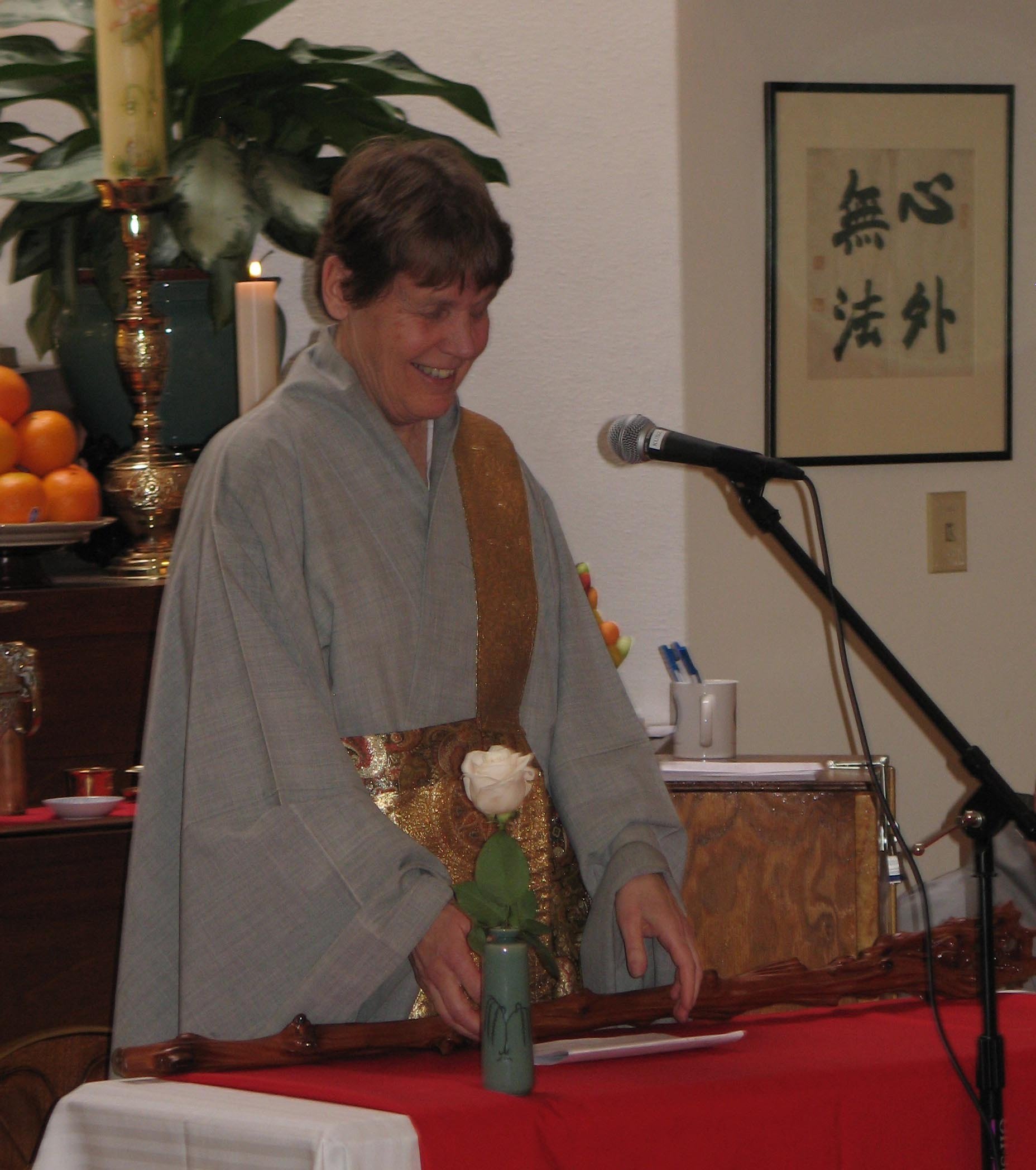
In honor of Zen Master Soeng Hyang, on her installation as the School Zen Master and Guiding Dharma Teacher.
Jump to next article
Una persona speciale
by John Holland
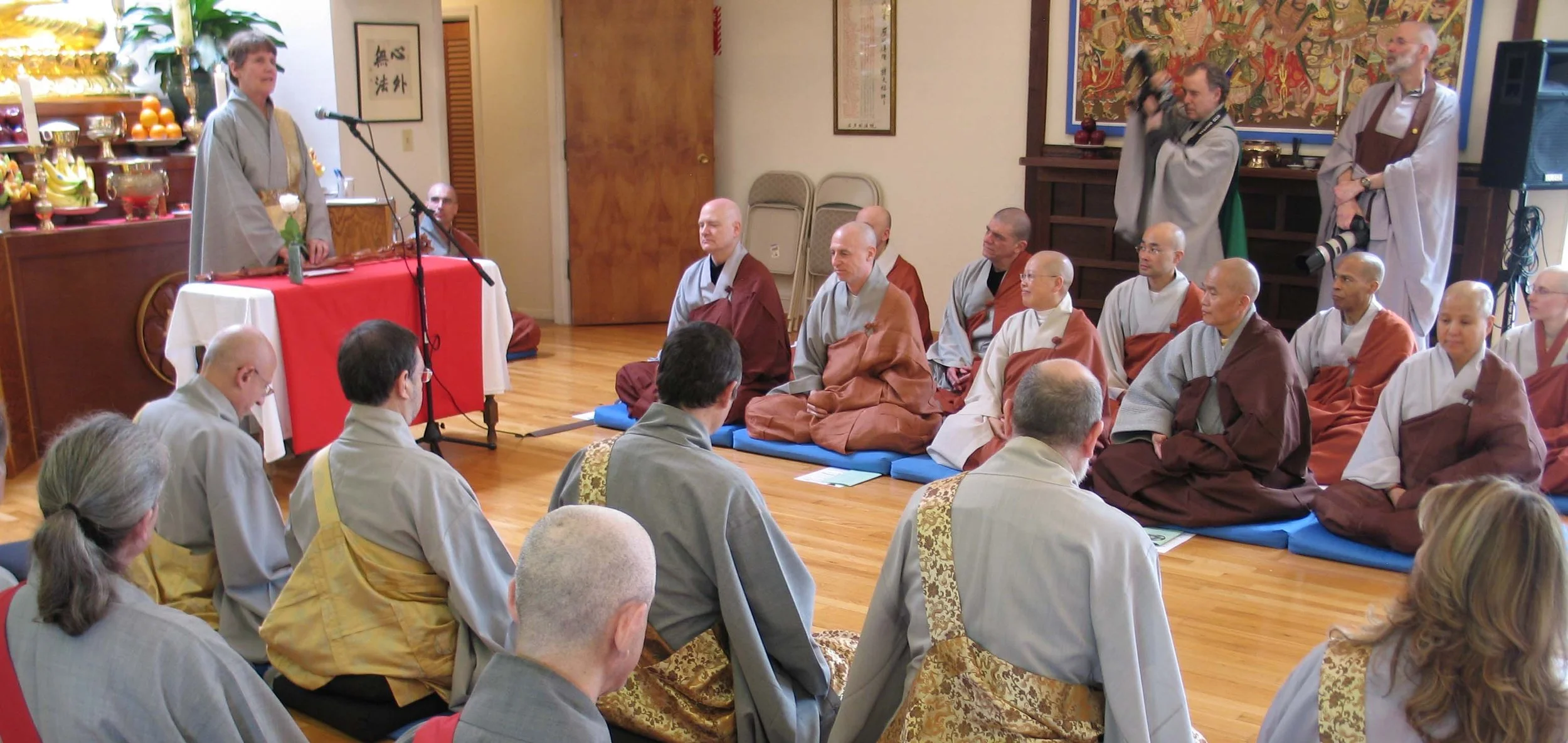
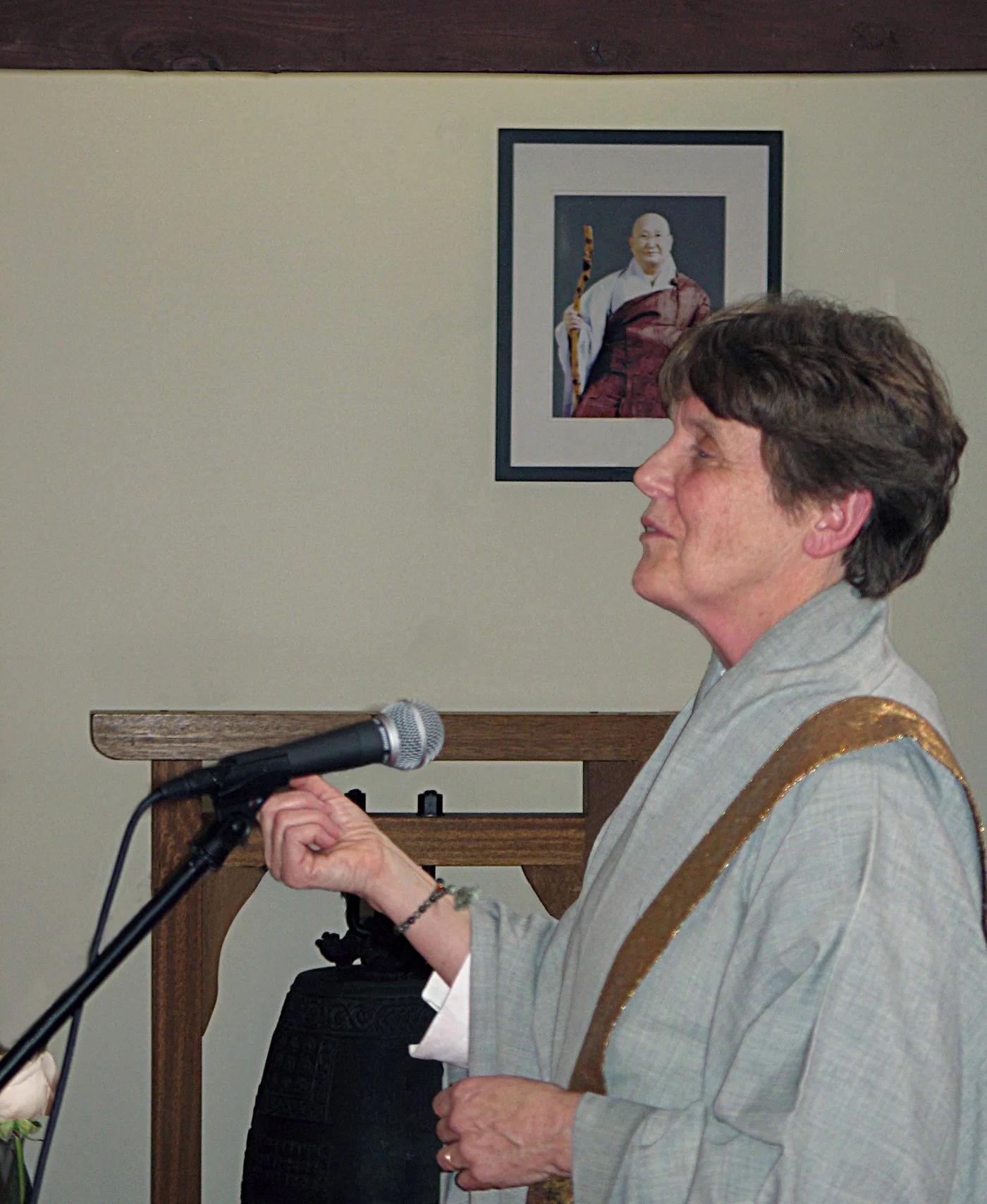
In front of 200 people at the first-ever installation of a School Zen Master at 1:30 on April 5, 2008, Zen Master Dae Kwang Sunim pointed out that Zen Master Soeng Hyang has already served three years of her projected five-year term. Teasingly, he suggested that perhaps other great institutions, like the US, might emulate the Kwan Um School of Zen and have its presidents complete a three-year probationary term. Of course, in reality we followed Korean Buddhist protocol in waiting three years until after the death of our Founding Zen Master to officially appoint his successor.
In her inaugural speech Bobby spoke of the importance of Try Mind and the need for encouragement from a teacher. When I heard this I was reminded that she led my first Yong Maeng Jong Jin retreat. After energetic bows, we launched into the Morning Bell Chant with such a lack of energy that the JDPSN (as Bobby Rhodes then was) halted the four of us saying sternly, “Even if you are new to this, you must do better.” After our second attempt at chanting more or less passed muster we began meditation. But little time elapsed until she admonished one of us for nodding off to sleep. Another ten minutes and noticing the reemergence of torpor, Bobby violently shook the person next to her. As a newbie I found all this intimidating. And later at my first-ever interview she may have detected obstinacy lurking within my nervousness for she was very firm with me and unforgiving of my ignorance and lack of perception. In her talk Bobby said that “If you feel discouraged that’s the demon in the corner. It’s not a bad thing to be discouraged.” “Believe in yourself,” “Embrace what is difficult.”
I like to think that some of my less-than-passive obstinacy to the formalities of our practice wore away because in subsequent visits to the Providence Zen Center I was often hugged by Bobby, who stood outside on the verandah to welcome morning arrivals on the Buddha’s birthdays. I was very impressed that a teacher of her stature would do this.
Over the years I have cherished the warmth of Bobby’s generous affection as well as her teaching. A year ago I was her attendant in New York. We went to the Japan Society to admire exquisite Buddhas and Bodhisattvas. When she said that she had had enough of them, we went to the Zen Center where we sat side-by-side for 40 minutes. I ascribed the samadhi that I experienced to being in her presence. Bobby quoted Dae Soen Sa Nim’s admonition to her, “This is NOT a school of samadhi, OK? This is not about feeling good. It’s about ‘How may I help you?’” Later over dinner at a nearby Korean restaurant she listened with great empathy to my account of my son’s demise. On the Sunday following the retreat led by her, we had one of the heaviest rainfalls that the city has ever endured. Bobby arranged to meet me in my local coffee shop on the Upper East Side. When I saw her there, enveloped in a rain cape talking on a cell-phone I was taken aback because the barista fiercely forbids the use of phones. When I thanked him later for not causing a rumpus, he replied, “Oh, I saw that she was una persona speciale.” We brought our coffee to my apartment where our stray, neurotic, cat Parker jumped onto the sofa to sit beside Bobby. Now this is a Kiplingesque cat who walks by herself and is a non-greeter. Bobby, however, said that she perceived her Buddha-nature, something that Parker has hidden from me for 14 years. Explaining as she did, that Dae Soen Sa Nim had given her the Buddhist name of Nature Smell because he knew of her delight in nature. “I am the compost queen. I love being outside,” she said. “Let Nature be your Teacher,” wrote Wordsworth. Bobby insisted that we slither across Central Park in the pouring rain to our appointment at New York Chogye Sa.
* * * * *
At Zen Master Soeng Hyang’s installation, some of the teachers from the US, Europe, and Asia made attempts to address aspects of this deceptively simple (special) person who has a penchant for leading with her weak suit and then turning it into trenchant teaching. I am reminded that Alan Watts explained in The Way of Zen, “This is like encouraging the growth of a hedge by pruning for, obviously the basic intention is to help, but the Zen student does not really know Zen unless he finds out for himself.” Zen Master Bon Shim, from Warsaw, described asking Bobby for advice on her relationship on her first visit to the Providence Zen Center. Bobby replied that she couldn’t give her any because she didn’t know why people fight instead of loving each other. At first Zen Master Bon Shim was disappointed in Bobby’s answer but on reflection came to overlook her own problem and focused instead on that kong-an. “We have,” said she, “a strong, compassionate head.”
Zen Master Dae Bong Sunim, who now lives in Korea, said of his first visit to the Providence Zen Center 30 years ago:
It was a Sunday night and when I came in already evening chanting was on. Somebody showed me to a cushion… at that time we were just starting the Korean Heart Sutra….I’m going “ma-ha ban-ya,” trying to read the thing. And this person next to me has, to me, this very strange voice. I grew up in Philadelphia and I was thinking, “There’s a cowgirl singing this Chinese stuff next to me.” I’m kind of expecting it’s going to be “ma-ha ban-ya, git along little dogie.” And it’s like “Wow, this is a really weird place!” But I kind of enjoyed the chanting, the feeling, and the sounds coming out and not knowing what it meant....Then afterwards we take a little break and there’s going to be a dharma talk and they say today the Housemaster will give the dharma talk. So I’m thinking now I’ll get a feeling of what this teaching is. It turns out it’s the cowgirl again. She gets up there and is sitting down, and the Zen Master is not there and it didn’t mean anything to me because I wasn’t thinking about anything just what’s going on here.
And she’s saying, “We all have ideas about things and we all think we know how to do some things. So today I was working at my nursing home and I go to peel a banana for this old patient and you know all of us peel the banana from the part that you pull off the bunch and,” she says, “this old guy says this is not the way to peel a banana,” and she says, “No come on, this is the way everybody peels it.”
He says, “No no it’s much easier from the other end.” Deep sutra stuff!
And then she says “No, no, no, everybody peels it this way.”
And he says, “It’s easier from the other end.” So finally he convinced her to peel it from the other end and guess what?
“It’s easier.”
And that’s the only thing I remember from the dharma talk.
The first two years I was living at the Providence Zen Center, like anybody practicing I was going through a lot of difficult emotional things. I would come home and the only person there would be the cowgirl who was home from work doing the laundry. So I would start to tell her about whatever heart problem I was having and we would always end up talking while hanging up the laundry. When I think about those two years, the times I was most felt, like [deep breath], where it was just like “Everything is OK,” was doing that together with her.
We talk about “Zen is Everyday life” and there’s all kinds of great poetical things you can say about it, but unless our everyday life really is our practice for us, not even our practice anymore, it’s just our life but it’s got Buddha’s way completely digested into it, then it’s just nice speech. I think for Zen Master Soeng Hyang it really is her everyday life, and the two have digested into one another. And I think that’s a great thing because there’s a lot of teaching that’s better organized and more beautiful speech but unless our practice really does connect completely with our everyday life, it’s just a nice hobby.
And certainly in Korea one thing that you notice that really connects with young people is our way of doing things, our way of relating to our life. It’s not so poetically beautiful but hopefully it’s filled with truth.
I think this simile about an outspoken cowgirl comes under Montaigne’s rubric: “Many things I would not tell anyone I tell the public [sangha].” Zen Master Dae Kwang Sunim told us another such thing:
I remember Dae Soen Sa Nim said one very important thing. It’s not so much the person; it’s who is holding this light that is very important. This head is somebody who is holding the dharma light. We are looking at the dharma light; not so much the person. So don’t check the person. Zen Master Soeng Hyang is very frank to tell her things to all of you… usually Zen masters don’t talk about their shortcomings, but Zen Master Soeng Hyang tells you everything. But behind is the dharma.… I represent our Zen Center from Hong Kong, all our students will support you as the head of our school.
This morning I saw something that really touched me…when we woke up very early. We have one monk here who has been a monk for 30 years and Zen Master Soeng Hyang walked right up to him and bowed to him. It’s not so much what you say as your action….How you relate to people. How would you relate with a sangha student? Are you hearing what they are saying to you? This is very important. I think we have a good head. Also … harmony is very important. If we live in a house, if we are in harmony, our school will be very strong.
It doesn’t matter what people talk about us. We look funky, I must say, from a Chinese angle. But if you see behind this funky thing actually there is a lot of good stuff inside. We need each other to help. We need all of us to help this school and turn into this dharma light. Our mission is to share this dharma light so all beings have this light and they don’t live in darkness.
I want to congratulate Zen Master Soeng Hyang and congratulate our school. So let’s become one: Head and body, hands and feet become one, not for ourselves but for all beings.
* * * *
Spring comes, grass grows by itself.
The blue mountain does not move.
White clouds float back and forth.