
Journal of the Chogye International Zen Center of New York
Editors: Guillermo Echanique, Jan Potemkin, Sheera Joy Olasky, James Gouijn-Stook, Albert Lee
A Dharma Talk or
“Don’t Skip Sangha”
Zen Master Wu Kwang
On the occasion of the 51st anniversary of the Zen Center
Photo: Albert Lee
Welcome, everybody. Thanks for coming to celebrate and commemorate our fifty-plus years.
It's kind of a miracle.
At home, I have a psychotherapy book that’s been on my shelf for about thirty years now, though I’ve never read it. I like its title a lot: Characterological Transformation: The Hard Work Miracle. And you could say that these fifty years have also been a hard-work miracle.
So, we have to feel grateful to each other, to those who were here before us and maybe went somewhere else, and to those who will appear in the future to carry on the Zen Center, which is not really a physical place, but us.
Dae Soen Sa Nim, Zen Master Seung Sahn, in 1975, shortly before the opening ceremony of the Zen Center, made that calligraphy that's on the wall over there, which is an empty circle. And then it says, “What is this?”
Zen Master Seung Sahn, 1975.
Photo: Albert Lee
And when we moved here, around 1987, we only had part of this room. Where you people in the back are sitting, that was somebody’s bedroom. The Dharma room was just this part. So, it was small.
Apartment 2E in 1994, before the Zen Center expanded into 2D.
Photo: Jan Potemkin
And the big Buddha that we had when we were together with the Korean sangha went out to Queens, where they opened a temple.
So, Zen Master Seung Sahn gave us this Buddha, and he said that because it's a small Buddha, we probably shouldn’t have the big, elaborate, ornate backdrop that they usually have in Korean temples. So, he said maybe just a Zen circle would be okay, or a Zen pagoda, something like that.
So, a Korean monk we knew here in New York, Sung Hae Sunim, made this for us.
He was a well-known Zen-style calligrapher, rather than a traditional calligrapher. So, the circle is kind of wild, yeah.
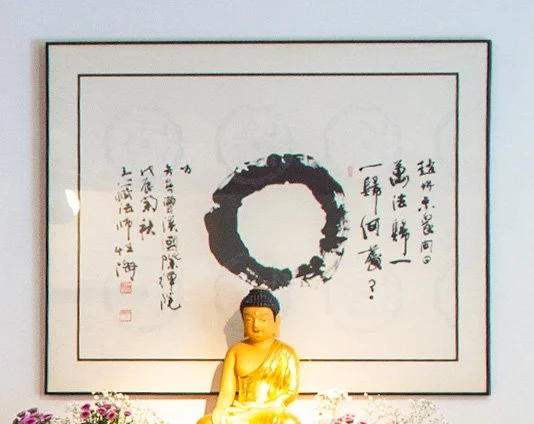
Circle by Sung Hae Sunim
Photo: Albert Lee
In any case, the circle, whether it’s that one, this one, or any one you find somewhere, really represents the teaching of empty and full.
Recently, I was with my Dharma brother, Dae Kwang Sunim, who’s about my age, and he's also had some significant health problems over the last couple of years.
And he said to me, “I used to think this teaching of old age, sickness, and death was kind of theoretical.”
[Laughter]
“Now I realize the living impact!”
And likewise, this teaching of empty and full, represented by the circle, is not theoretical.
And if we look at it in terms of sangha, what actually is empty, and what actually is full?
In a sense, each of us is empty of self-sufficiency. None of us exists on our own, standing independently. And we're also empty of permanence.
Dae Kwang Sunim really brought that home.
So, the way we exist, in reality, is interdependently. The individual makes the sangha, and the sangha supports the individual.
And if we were going to become really esoteric about it, you could say that each individual is the whole sangha. And if you don't quite understand that, then the perplexity is important.
So, last week when I was giving interviews, someone came in. You know, we encourage students to come in with a question, a challenging question or some question about their life.
So, this person came in with a kind of challenging question, and she said, “Are you still a Zen master?”
And I said, “Go ask my teacher.”
You know, I got the title of Zen Master from my teacher, and I don't know whether he still thinks I’m a master or not. But my teacher has been dead for quite a few years now. So, if she were going to ask him, she would have to have some miraculous powers of her own.
So, the student makes the teacher. The teacher makes the student. The sangha makes each of us, and each of us makes the sangha.
And that’s the empty side of this.
Last Saturday, when I was here, we were chanting the Homage to the Three Jewels, and the Three Jewels are the Buddha, the Dharma, and the Sangha.
And when we got to the paragraph about sangha, someone, as happens once in a while, jumped ahead as if they were going to skip that paragraph. But everyone else was in the right place, so they brought the person back.
But I thought to myself, “No, no, don’t skip Sangha!”
Sangha is most important.
So, the other side of this empty-full teaching is: What is it full of?
If it’s empty of permanence and independent existence, it's full of possibility and potential.
And that’s how we've gotten along for fifty-plus years. And hopefully, the possibilities are endless and open and wide, and we will continue to get along and support each other.
And so, I thank everybody for coming today and participating in this celebration.
Just in closing, I heard the Dalai Lama one time speak about the good news of Buddhism. He was playing on the Christian word “gospel,” which means “good news.”
He said, “The good news of Buddhism is that everything changes.”
So, we’re not stuck, and everything is evolving and evolving, and hopefully moving toward a greater good that we all innately have in us.
So, thank you all for coming, and I hope everybody enjoys themselves this afternoon.
51st Anniversary Celebration
On May 9, 2026, the sangha gathered to celebrate the Zen Center’s 51st anniversary.
Photo: Sheera Joy Olasky
Zen and the Arts
Zen Practice and Art
Guillermo Echanique
In common parlance, a moment of Zen is a brief, and often surreal video clip. It forces viewers to step back from analytical thought and process a strange piece of reality. Yet, in our practice, we do not refer to any moment as separate from our daily lives. If there is a moment of transcendence or clarity it is because the moment points to the unity of all phenomena.
Consider Zen Master Seung Sahn teaching that “everyday mind is Zen mind.” Every day, every aspect of our lives, every encounter, is already complete as it is. A caveat is that we should not attach to the moment or the experience. We should let it appear and disappear much as clouds move in the sky.
How can we then explain Art? Is Art already a concept unimportant to our practice? Of course not. But its seeds are there.
In this section
Zen Practice and Art — Guillermo Echanique
Kyol Che Haïkus — Manu Won Jin
A haiku exchange — Jan Potemkin & Manu Won Jin
Seeing with intention — Tony Sager
After Brush-painting Practice in an Autumn Rain — Jan Potemkin
Stars, Sky Burial, Earth’s Kata — Michael Bournas-Ney
Wooden Indonesian Kerises — James Gouijn-Stook
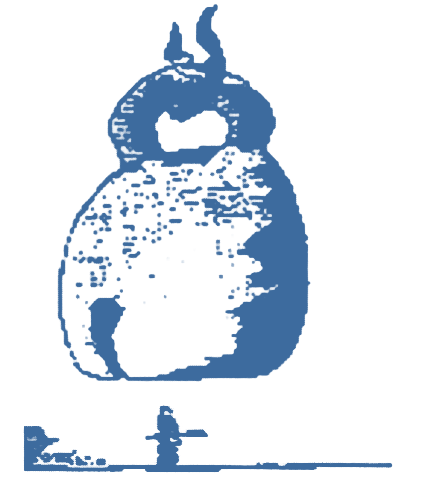
Listen to me!
Hey you down there!
You think you understand Moktak mind?
Well, listen to me!
You haven’t had your belly scraped out yet.
If you had started that kind of thing,
you wouldn’t sit there so quietly,
flattening out your butt day by day.
You’d be screaming, your eyes would bulge out,
and you’d head out the door and never come back.
But what’s the big deal?
In the end, you get a big round hollow gut,
and then…
tak, tak, tak.
Listen to Me!
Jan Potemkin